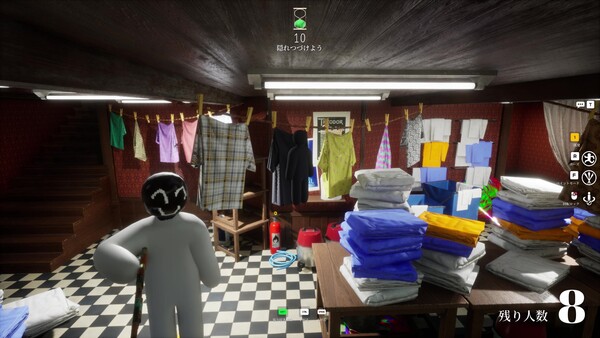
Mansion is the surface-variety map: 12 measured surface families from damask wallpaper to bathroom marble. Since update 2.2.0 randomizes furniture, learn surface families instead of fixed spots.
Last checked: 2026-07-12
Source basis: official Steam News for update facts; surface color values are community-measured (Steam guide, linked from our color codes library) — center-of-range starting points, not official data. Following our editorial policy, this page teaches surface strategy and does not invent “guaranteed hiding spots”.
Hide-and-Seek Mansion is the map most players learn first, and the one where memorized spots decay fastest: official update 2.2.0 randomizes furniture and other elements, so a spot that existed last round may literally not be there now. What persists between rounds is the surfaces — and Mansion has more distinct surface families than any other base map.
Maximum surface variety, medium brightness, heavy patterning. Your edge here is choosing the right surface family fast, because furniture layouts will not repeat.
The map's measured palette — click a band to copy its hex. Full table below.
All measured Mansion surface colors
2c3611698590351d0e · 402513 · 18120ed0c9aa · d5cab8 · b1966c8a6a49 · 3114076e3624 · 796440 · 594a56 · eae2cabebeb7205877042722481d17481f0e664c33 · 2d2316How to read this palette
Three things stand out in the measured data:
- The woods are much darker than they look. Paneling reads as “brown” but measures nearly black (
18120e,311407). If you paint from memory instead of sampling, you will come out several shades too light — a classic first-clue giveaway. - The wallpapers are patterns, not colors. Green damask (
2c3611) and blue damask (698590) only work if your pose follows the repeat. A perfect hue with limbs crossing the motif reads as damage in the pattern. - The bright tile zones are exposure zones. Cream checkerboard (
d0c9aa–b1966c) and kitchen tile (bebeb7) are high-value surfaces where your body’s shading gradient shows. Painting bright is harder than painting dark, because your own shadow betrays you.
Room families the surfaces imply
The measured surfaces map to recognizable zones — library shelving and book spines, kitchen tile and blue mosaic, bathroom teal marble, laundry red wallpaper, leather furniture, and brick storage walls. Treat each as a different paint problem: book spines are a multi-color cluster where imperfect stripes blend; bathroom marble (042722) is dark and glossy so roughness matters more than hue; brick storage (664c33 / 2d2316) tolerates rough, patchy paint jobs.
Hider approach
- During prep, pick a surface family, not a spot — randomization means the furniture will differ, but wallpaper, floors, and built-ins persist.
- Prefer zones where two families meet (wall + wainscot line, shelf + spines): seams break your outline for free.
- Score the position with the spot-score checklist before painting.
Seeker approach
Enter each room and scan for pattern breaks first — Mansion’s wallpapers make interruption obvious once you look for the repeat instead of colors. Then check bright floors for shading anomalies, and treat any “furniture” you do not remember with suspicion: randomization cuts both ways, so verify shapes against the room’s logic, not your memory of last round.
Update history that affects this map
- update2.2.0 — furniture and element randomization added (the defining fact of this map).
- Official notes say random elements are planned for all maps, so expect Mansion’s behavior to spread. Track changes on the updates timeline.