Latest important items: update2.7.0 added Egypt and Penguin Hotel random elements, update2.6.0 added HIKAKIN Museum and controller alpha, and EOS maintenance is scheduled for July 21, 2026 JST.
Last verified: 2026-07-17 Source basis: Public developer posts in Steam News. This page translates patch notes into player impact and links back to Steam for the original wording.
MECCHA CHAMELEON updates have changed more than isolated bugs. Recent public notes added new map content, map lottery controls, random elements, controller-alpha work, regional tags, FOV changes, anti-cheat countermeasures, and a scheduled EOS maintenance window. Older updates also made maps less predictable, added optional Hunter ammo, introduced Reverse Chicken Race, and reworked Osaka.
This timeline uses the update labels shown in Steam News and only summarizes the facts players need for hosting, hiding, seeking, or troubleshooting. Open Steam News for complete wording and any later corrections.
Verified update path
From map variation to modes, map reworks, and enforcement
Latest important information
Notice — EOS matchmaking maintenance on July 21, 2026
Steam News says the game’s EOS matchmaking system is scheduled for maintenance on Tuesday, July 21, 2026 at 3:00 PM JST. The notice expects about 60 minutes of downtime, followed by up to 1 hour of reduced service availability.
Player impact: do not schedule community events, tournaments, or first-time group sessions inside that window. If matchmaking fails during the maintenance window, treat it as service status first rather than a local network problem.
update2.7.0 — Egypt, random-map controls, Penguin Hotel randomization
The update added the new official map Egypt. It also added random-map lottery toggles so hosts can choose whether each map appears when random maps are used; collaboration maps are OFF by default. Penguin Hotel gained random elements, and a HIKAKIN Museum wall-stuck issue was fixed.
Hider impact: Penguin Hotel routes should no longer rely on a single fixed room arrangement. On random maps, confirm the host’s lottery settings before expecting a particular map pool.
Seeker impact: update your Penguin Hotel scan route for random elements, then re-learn Egypt as a surface and sightline problem rather than importing Mansion or Osaka habits.
Host impact: random-map toggles are now part of lobby setup. If a group wants to practice one map family, check map inclusion before starting.
update2.6.0 — HIKAKIN Museum, controller alpha, region tags, Hunter FOV
The update added the collaboration map HIKAKIN Museum with collaboration-exclusive gimmicks. It also added controller support in alpha form, with UI operation not supported; added Japan, South Korea, and East Asia to region tags; fixed clone collision remaining after a clone was hidden; and adjusted Hunter FOV from 100 to 105.
Hider impact: the wider Hunter FOV can make edge-of-screen exposure more punishing. HIKAKIN Museum should be treated as a gimmick map until you learn its specific interactions.
Seeker impact: FOV 105 improves peripheral information, but it can also tempt sloppy scanning. Keep using a fixed route instead of sweeping randomly.
Input impact: controller support is alpha, and UI operation is not supported in the note. Keyboard/mouse remains the safest assumption for setup and menus.
Earlier timeline
update2.2.0 — Mansion randomization
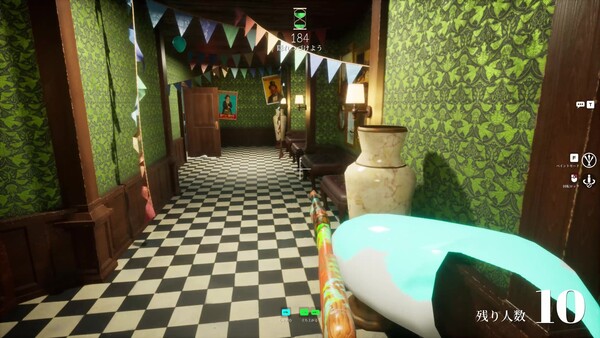
The Hide-and-Seek Mansion received randomization for furniture and other elements. The durable takeaway is that a familiar room is no longer guaranteed to have exactly the same arrangement every round.
Hider impact: fixed-location hiding recipes lose reliability. Scan the generated layout before committing, then match paint, material, silhouette, and spacing to what exists in that round. A strong location in one Mansion layout may look conspicuous in another.
Seeker impact: memorize environmental rules rather than a single prop list. Look for broken alignment, implausible spacing, paint that reacts differently to light, or a shape that does not fit the current room.
Multiplayer impact: repeated Mansion rounds should demand more live observation and less route repetition. Hosts and guides should avoid promising an “always safe” position.
fix2.2.1 — Sewer variation and AMD decoy fix
The follow-up added minor random elements to Sewer. It also addressed decoys appearing completely black on AMD GPUs. These are separate changes: one affects map variation, while the other concerns visual correctness on particular hardware.
Hider impact: Sewer knowledge still helps, but check the current arrangement before using a rehearsed blend. AMD users affected by black decoys gained an official fix rather than needing to treat the appearance as normal gameplay.
Seeker impact: do not assume every changed object is a player; some variation is intentional. Conversely, hardware-specific rendering trouble can distort evidence, so suspicious visuals should not automatically be read as clever camouflage.
Multiplayer impact: if one player still sees black decoys, compare versions and hardware before blaming the host or another player. The patch note confirms a fix, but it cannot guarantee every later rendering problem has the same cause.
update2.3.0 — optional Hunter ammo limits
This update added an optional ammo limit for Hunters. Under the documented rule, a miss consumes one ammo, a hit restores one, and Hiders win if every Hunter runs out.
Hider impact: provoking uncertain shots becomes a win condition, not merely a distraction. Ambiguous paint, believable positioning, and decoys can pressure Hunters into spending a finite resource.
Seeker impact: accuracy becomes resource management. Fire after multiple clues agree—shape, material response, placement, or movement—instead of testing every suspicious surface. A confirmed hit can sustain the search; repeated guesses can end it.
Multiplayer impact: because the setting is optional, teams should verify lobby rules before interpreting a loss. Hosts can use ammo limits to discourage indiscriminate firing and make deduction more important.
update2.4.0 — Reverse Chicken Race
Reverse Chicken Race added a mode in which players infer a hidden player’s identity from body paint, race to locate that player, and score for finding them first; hiding unnoticed also earns points. The highest score determines the winner according to the summarized official rules.
Hider impact: paint now communicates clues about identity as well as helping camouflage. Staying unnoticed matters directly to scoring, so a visually convincing blend must also survive opponents who are actively interpreting that clue.
Seeker impact: deduction and navigation happen together. Identifying the likely target is not enough if another player reaches them first.
Multiplayer impact: explain the objective before a mixed-experience lobby starts. It should not be treated as ordinary team Hide-and-Seek with a renamed scoreboard, and current in-game wording should override an older summary.
update2.5.0 — Osaka rework and experimental palette
Osaka was reworked. The same update also added an experimental color palette described in connection with upcoming controller support.
Hider impact: re-scout Osaka rather than importing old hiding routes. Changes to geometry or object placement can alter sightlines and whether a paint match is convincing.
Seeker impact: rebuild the search route from the current map. Old assumptions about boundaries, transitions, or common hiding areas may no longer apply.
Multiplayer impact: the experimental palette is evidence of controller-related work, not proof that complete controller support was finished. Verify current input behavior in-game before organizing a controller-only session.
fix2.5.1 — Osaka boundary and anti-cheat follow-up
The follow-up fixed an Osaka out-of-bounds issue and introduced countermeasures against excessive recommendations and rapid-fire cheats.
Hider impact: an out-of-bounds location should not be considered a legitimate or dependable hiding strategy. Play inside the intended space even if an old route appears reachable.
Seeker impact: do not waste a round reproducing an obsolete boundary exploit. If suspicious rapid-fire behavior remains, document what happened rather than assuming every fast action proves cheating.
Multiplayer impact: the note confirms targeted countermeasures, not a guarantee that cheating is impossible. Hosts should use current moderation options, and players should distinguish direct observation from accusation.
How to verify the current state
- Check the game’s displayed version and lobby settings.
- Read the latest entries in Steam News for newer changes or corrections.
- Treat the in-game map and rules as authoritative for the match you are playing.
- Use Steam Discussions as player-report context, not as proof that an issue affects everyone.
This page was last checked against cited public update facts on 2026-07-17. Newer Steam News should override this summary if another patch or service notice appears.
Continue by player problem
- Map randomization or an Osaka route changed → Maps Guide
- A current symptom may be a regression → Known Issues and Fixes
- Reverse Chicken Race or ammo rules are unclear → Game Modes Guide
- You need the primary official source → Steam Source Guide